Somehow, the return of the light
The light in St. Augustine, the nation’s oldest city, is a magical thing to behold. Whenever I am here, I am up early, walking the streets, memorizing the landscape.
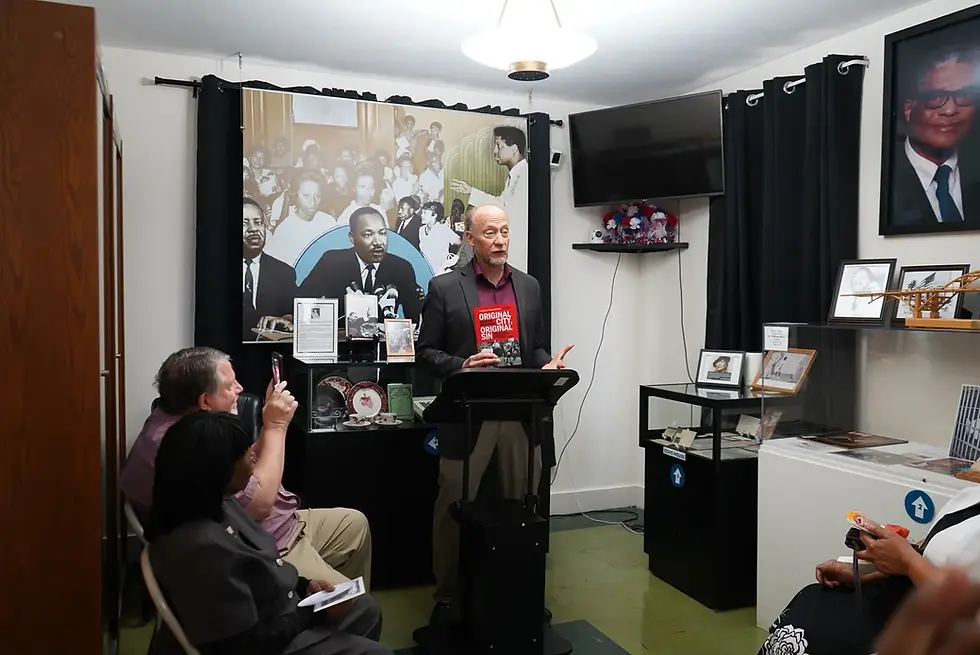
Sunday had been unforgettable. Civil rights history returning to the sacred terrain of Dr. Hayling’s old dental office, now a tiny but mighty museum, standing on those green and black linoleum tiles. It was the civil rights version of the field of dreams, almost as if they had walked in out of a cornfield in Iowa—except that they walked back through pain toward hope of an America that they still somehow believed in.
Cora Tyson, 103 years of dignity—the woman who hosted Dr. King one night as he was moved from house to house for his own safety.

Irwin Brunson, then an artistic fourth grader, one of five Black kids trying to integrate a school, learning to draw to combat hate—and now his artwork is on display at the museum.
James Jackson, captured and beaten by the Klan, now gaunt and frail, his words slow and hard to summon, but still somehow he rises.

Audrey Nell Edwards Hamilton, fiery still: the last surviving member of the legendary “St. Augustine Four” who paid for a sit-in at Woolworths with six months in jail and reform school—now she leads us all with a beautiful rendition of “We Shall Overcome.”

The only kind of history I could write is an intimate one, a journalistic one, based on deep listening and trying my very best to understand. It had to be a history perched on a foundation of empathy.
On Sunday, I felt the damage in the room, the pain, the lives that had careened in part because of unfairness and cruelty. But also, I felt the persistence of a certain light, a refusal to give up.
I recalled my one phone call with Dr. Hayling, the two-hour one in July 2015. He was 85 then, his voice very faint. I had to push the cell phone seemingly all the way into my brain to hear his words. But when I asked him how long he would be pushing for civil rights—this man who had his teeth knocked out and his fingers broken by the Klan; this man who had his house shot into by night riders, killing his dog; this man who had been so demonized by some people in this city—he managed to find a tone of defiance: “Until the last day of my life.”
That day was not far off. He died in December. I had to be there for the memorial service in February, an outpouring I will never forget. Afterward, we spilled out of the St. Paul AME Church as bagpipes played. Out on the street (now named after Martin Luther King, Jr., whose life was creditably threatened here on multiple occasions), representatives of the police and fire departments gathered. They had been no friends to Dr. Hayling back in the day. Far from it. But now they joined forces with vehicles pointing in opposite directions and hoisted this flag. I took the picture with tears in my eyes.

I couldn’t help remembering that moment on Sunday afternoon as these civil rights heroes gathered in his dental office.
Early on Monday morning, I walked past the dental office, out to the Plaza, and through the old Slave Market. I crossed the street and climbed out onto the Bridge of Lions over the Matanzas River. The wind was gusting all around. Pelicans glided along without a single flap of the wings. And off to the east, something happened that was just so ordinary and yet so exceptional.
Over America’s oldest city, the sun—it rose again.

Comments