When history walked into the room
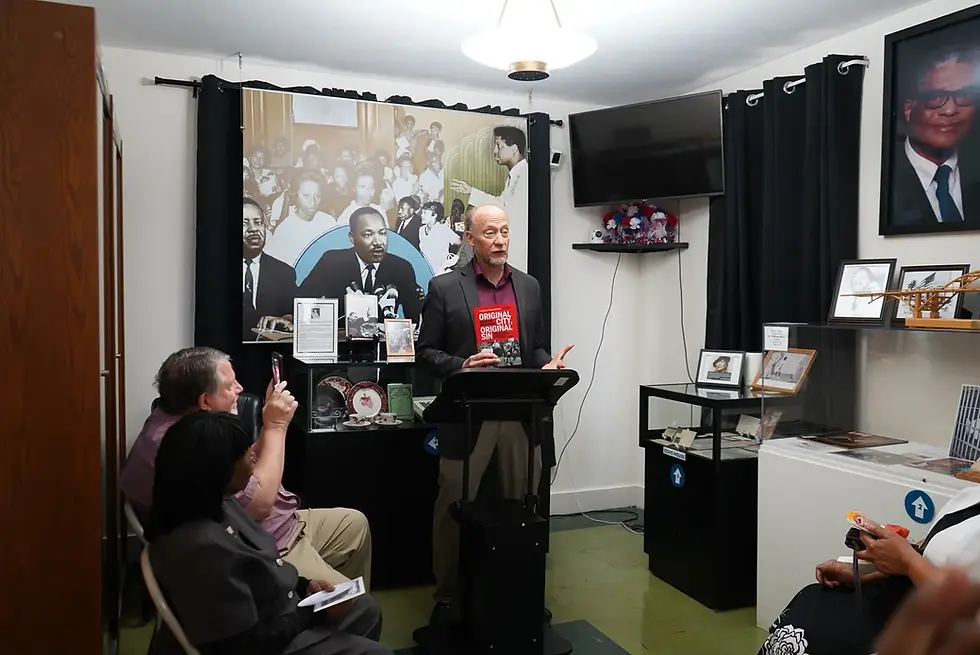
Yesterday afternoon felt like a scene from a dream.
The setting: the old integrated waiting room of Dr. Hayling’s dental office with the green and black linoleum tiles. The place where, long ago, Doc gathered with his young civil rights proteges like Audrey Nell Edwards and JoeAnn Anderson and James Jackson. The place where a shy fourth grader named Irwin Brunson, son of two deaf parents, came to get his cavities filled. The place where a soft-spoken neighbor named Cora Tyson entered from across Oneida Street, her house just 30 feet away, to talk with the dentist about the challenges of life in St. Augustine, Florida, the nation’s oldest city, one grappling with its ancestral challenges around race.
The office at 79 Bridge Street sat at the front edge of Lincolnville, the Black neighborhood that had been settled by freed slaves and named after the man who freed them. A century after that emancipation, Dr. Hayling’s office had become the epicenter of local civil rights: the dignified dentist the most hated man in town by some, the most beloved by others.
Days had given way to decades. The dentist and his family were chased out of town, but he lived long enough for some vindication. The street (where night riders had shot into his home, killing his dog, who was guarding the family) was now named for him. The small dental office in 2014 became the first civil rights museum in the state of Florida. His memorial service a few years later at St. Paul AME Church, just a few minutes’ walk away, had been an outpouring of healing and praise.
And now, 2026, the 250th birthday of the country (though the 461st of its oldest city), a rainy day in late October. The dream merges into my own story, my own obsession, over years to write about this critical chapter of under-reported American history, to hold its heroes to the light. And so, at long last, the book: Original City, Original Sin: King, the Klan, and the Fight for Civil Rights in St. Augustine, Florida.
(Ah yes, King, because he, too, was a presence here: arrested, jailed, targeted for the assassination that he knew was coming at some point.)
But the dream, the dream. Onto those linoleum tiles, history walked back into the room to join me in this most golden of moments.

Over here, Irwin Brunson. That former fourth grader with the cavity, his deaf parents long gone, the memories of that year of racism indelible. The burning of his parents’ car when they were at the PTA meeting. The firebombing of his neighbors’ house, the Robersons, because they, too, were trying to integrate the Fullerwood Elementary School. Irwin making sense of it all through his art back then as a child. Now, in his early 70s, his art is on display at the museum.
And here, my goodness gracious, it’s Audrey Nell Edwards Hamilton: wearing her pins with an American flag and the crest of St. Augustine, loyal to both, but full of fire still from all those years ago. She was one of the legendary St. Augustine Four—the teens sent away for six months of jail and reform school for a nonviolent sit-in at Woolworths. An absurdly cruel sentence for trying to make the country live up to its promises of equality.
Irwin and Audrey Nell, eight years apart, a common badge of suffering, both part of the city’s anguished and beautiful history. They lived two miles apart, and both live in the city now. But somehow, today, they are meeting for the very first time.

Audrey Nell is the lone survivor from the St. Augustine Four. Samuel White and Willie Carl Singleton, tormented in ways we will never know at Marianna (read Nickel Boys if you can stomach it), both are long gone. And JoeAnn Anderson Ulmer, the fourth, Audrey Nell’s close friend, gone since 2020. For many years, Audrey Nell did not talk about any of it—not even to me for the book. It was too painful. But now here she is, her face becoming a fireworks display of joy when she is introduced to Katrina, and Wilma, and Michelle—JoeAnn’s daughters! They are here from Jacksonville, visiting the museum for the first time.
It goes on and on, the dream. Audrey Nell is not the only survivor here. The spectral form of James Jackson, resplendent in an argyle sweater, enters the room. Long ago, in September 1963, as a member of Dr. Hayling’s NAACP Youth Council, he had raced over to the office with a handbill he had found at the Plaza by the Slave Market: “Doc, Doc, you have to see this.” There was going to be a Klan rally that night in St. Augustine. The two of them, and two other Black men, would try to observe from a safe distance, only to be captured, and beaten severely, and almost—good God—burned alive. Three of those men have now passed, but James Jackson has somehow entered the waiting room.

It would all be more than enough, far more than enough, to make every second of a 20-year book project worth it, but then…one more. The woman with uncompromising elegance, the grandest of grandes dames of St. Augustine, courage and dignity flowing from her at every turn: the one and only Cora Tyson.

She is 103 years old. She hosted Martin Luther King back in the day. She challenged him about his nonviolence. She watched the parade of pain across the street at Dr. Hayling’s office. Earlier on this dream day, she had been at the St. Paul AME Church, where she still cooks, where the kitchen is named for her. And now she is here with her perfect posture, her quiet wisdom, her astonishing perseverance. I have inscribed a book for her, for all of these remarkable people. But she also signs a copy of the book for me: “Love you,” she writes, in a still-steady script, “for all you do.”
Right back at you, Mrs. Tyson.
The history in this room on this day is dream-like. But it is also beautifully, painfully, heart-meltingly real.


Comments