The youth will set you free

I am no longer a young person. But in the best sense, young people keep me young.
I am about to enter my 33rd year of full-time teaching: five at the high school level, and heading into year No. 28 teaching journalism at Springfield College. And there were similar positions before that: subbing in elementary schools, three summers tutoring inner-city high school kids at Upward Bound during college, and several others working in camps as a teenager.
I am no longer a young person. But in the best sense, young people keep me young.
I am about to enter my 33rd year of full-time teaching: five at the high school level, and heading into year No. 28 teaching journalism at Springfield College. And there were similar positions before that: subbing in elementary schools, three summers tutoring inner-city high school kids at Upward Bound during college, several others working in camps as a teenager.
Thanks for reading Civil Writer! Subscribe for free to receive new posts and support my work.
Over these many years, I have found that young people keep me growing, keep me (semi) relevant, and challenge me in ways that are healthy. Young people smell bullshit. They keep you real.
There have been many great experiences with students over the years. Arguably the highlight has been civil rights trips to the South over spring break: to places like Washington, DC (the African American Museum of History and Culture and the Holocaust Museum); Alabama (the 16th Street Baptist Church in Birmingham, the Edmund Pettus Bridge in Selma, the Legacy Museum in Montgomery); and St. Augustine (meeting with veterans of the local civil rights movement).
Images from civil rights trips with students: at the Ebenezer Baptist Church in Atlanta, and at the Edmund Pettus Bridge in Selma, Alabama.
Seeing the injustice through the eyes of young people made me feel it so much more acutely: when, for instance, James Jackson told my students in 2019 what it was like to be captured and beaten at a Klan rally in St. Augustine in October 1963.

Or when Cora Tyson—then 95 (now 103!), fighting through tears, said:
“The experience I have had over my 95 years is unbelievable…I honestly didn’t know people were that mean. When I found out that this was happening, it did something to me spiritually. It still does. I don’t talk about it. I used to go to school and talk about it to the children. I told myself, ‘I can’t do this no more.’ I’m crying, and the children are crying. I can’t do this no more. And it’s still that fresh with me today. But if we don’t tell you, you won’t know.”

Truth is, it’s hard to be young these days. Young people have been given a raw deal. The world that they have inherited from older generations is poisoned environmentally and corrupt politically. Core values about being good humans (honesty, respect, being your brother’s keeper, etc.) just are not modeled that well by some in power.
There is a tendency among young people to opt out, to zone out, to lean out. It’s completely understandable, but also tragic. Because what we desperately need at this point is the opposite: for young people to lean in.
It’s an utterly unfair ask, but it’s also true that great movements for change have always been led by young people.
Civil rights? Martin Luther King, Jr. was 34 when he gave his “I Have a Dream” speech at the Lincoln Memorial. And John Lewis—he of “good trouble” fame—was all of 23.
The environmental movement? Swedish climate activist Greta Thunberg was the Time magazine Person of the Year in 2019—at 15 years of age.
Pakistani activist for girls’ education Malala Yousafzai was 17 when she won the Nobel Peace Prize in 2024.
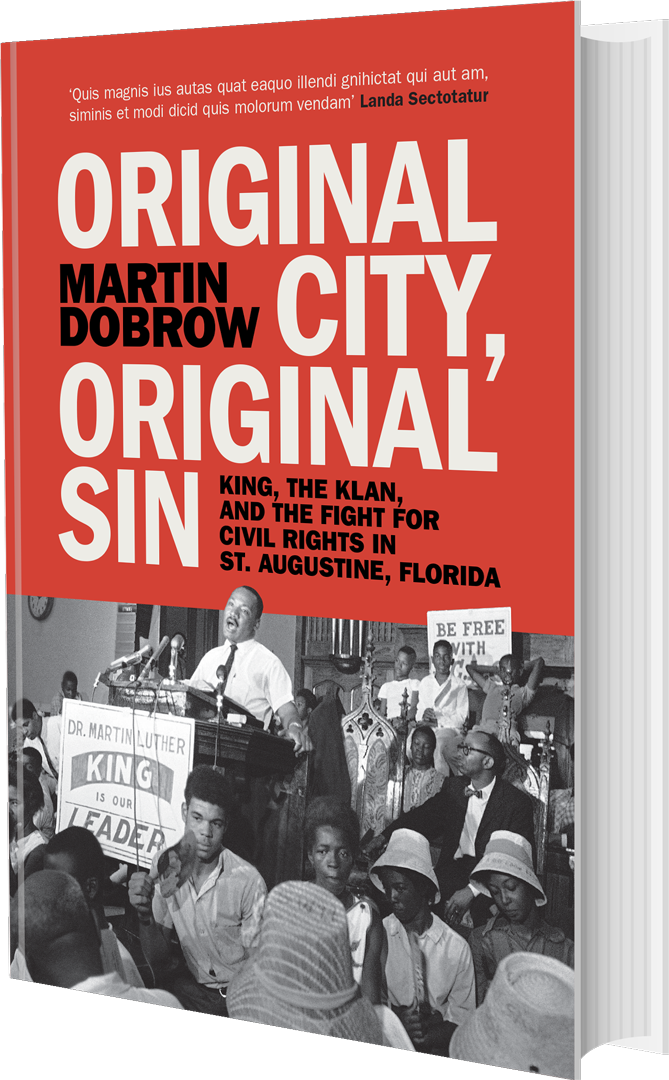
I know the conventional wisdom that young people don’t read much these days. But I have overridden that wisdom by writing a serious book about civil rights history (Original City, Original Sin: King, the Klan, and the Fight for Civil Rights in St. Augustine, Florida). I was inspired by the courage of so many young people who stood up for their rights and for American democracy at a pivotal moment in the nation’s history. Many of the stars of my book were young—everywhere from fourth grade through college—courageous individuals who stepped up for a cause that was bigger than themselves. My hope is that their stories will be inspiring to the young people of today.
Today, July 18, is a significant anniversary in St. Augustine. It was 63 years ago today when the St. Augustine Four—Audrey Nell Edwards, JoeAnn Anderson, Willie Carl Singleton, and Samuel White—conducted a nonviolent sit-in at the local Woolworth’s, trying to order that iconic American meal of a hamburger and a Coke. None of them had a police record. But they were all arrested and wound up spending six months in jail and sadistic reform schools in an appalling miscarriage of justice.

There is an old saying that “youth is wasted on the young.” I’d like to amend that to say that “Old age is wasted on those who don’t respect the power of youth.”
Thank you: Audrey Nell, JoeAnn, Willie Carl, and Samuel.
You paid a steep price for your activism.
You made us a better country


Comments